
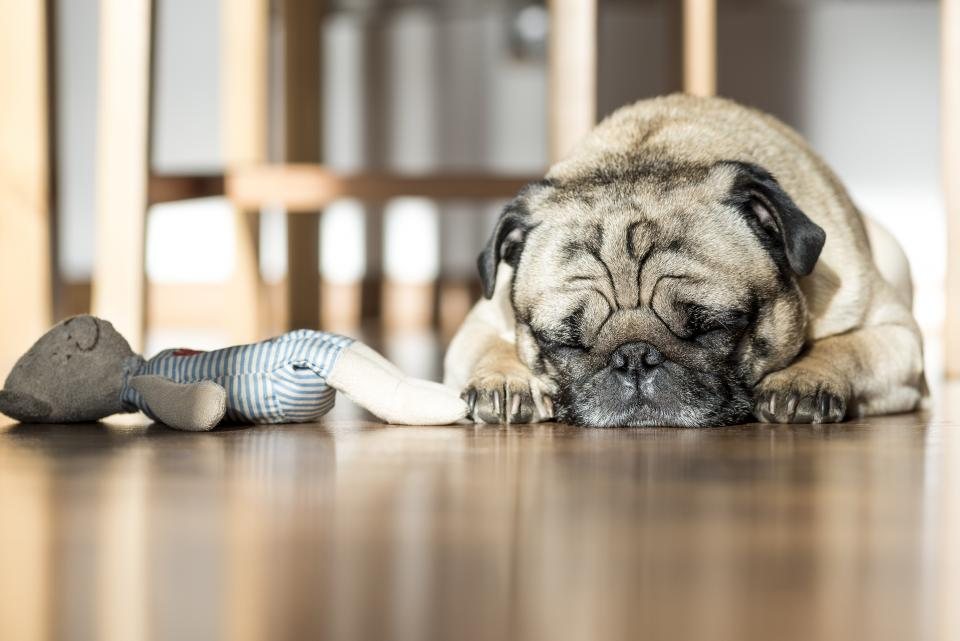
We plan our dogs’ outings with care: the route, the water, the snacks, the harness. We plan their recovery hardly at all, and yet recovery is where fitness is actually built. A dog that hikes 20 kilometres on Saturday and then sprints at the park on Sunday is not getting fitter; it is accumulating fatigue, and fatigue is where the soft-tissue injuries and the strange behavioural changes come from. This article is about the other half of an active life: how much a dog sleeps, why rest days matter, and how to recognise the quiet signs of a dog that is being asked for too much.
How much a dog sleeps, and why it is more than you think
An adult dog sleeps around 12 to 14 hours in every 24, and a working-breed adult that has had a hard day will sleep more. Puppies sleep 18 to 20 hours, and elderly dogs drift back toward that figure. Dogs are polyphasic sleepers: rather than one long night, they take a night of several cycles plus a series of naps through the day, and each cycle passes through light sleep, deep slow-wave sleep and a short period of dreaming sleep in which the paws twitch and the dog may whimper. Research on sleep in dogs has shown that they, like us, consolidate learning during sleep; a dog trained in the morning and allowed to nap remembers the exercise better than one kept awake and busy.
What matters for an active dog is not only the total but the quality. A dog that sleeps in a cool, quiet, dark place, on a bed that supports the joints, recovers better than one dozing on a tiled floor in a busy kitchen. On a camping trip, the change of environment, the noise and the cold often mean a dog gets far less deep sleep than at home, which is one reason the second and third days of a multi-day hike are harder for dogs than the first.
What a rest day is, and what it is not
A rest day is not a day of nothing. It is a day of gentle, low-impact movement: a sniffing walk on the flat, a swim, some scent games in the garden, and a lot of sleep. The point is to keep blood moving through muscles that are repairing themselves while removing the loads that caused the micro-damage in the first place. After a big outing, a fit dog needs one such day; after an unusually long or hard one, or in a dog that is still being conditioned, two.
Across a week, the rhythm that suits most active dogs is two or three hard days separated by easier ones, never two hard days in a row. Across a season, a lighter week every fourth or fifth week lets accumulated fatigue drain away. The same principle that governs human endurance training applies here: the body adapts during rest, and the training stimulus is only useful if the rest follows.
Building up without breaking down
The rule of thumb used by sports veterinarians is to increase the weekly load, whether measured in distance or time, by no more than about 10 percent. A dog walking 20 kilometres a week in early spring can be at 40 within two months, but not within two weeks. Terrain counts as load too: a rocky, steep 10 km is far more demanding than a flat 10 km on grass, and a dog moved from one to the other needs the same gradual introduction. Carrying a pack should start empty and be built up over weeks toward a maximum of 10 to 15 percent of body weight for a fit adult dog, and less on rough ground.
Young dogs need one more restriction. The growth plates at the ends of the long bones close at roughly 12 months in small breeds and 18 months or later in large and giant ones, and repetitive impact before then, such as long runs on hard surfaces or repeated jumping, is associated with joint disease later in life. Free play and short walks are fine; long structured hikes should wait until the skeleton is finished.
Recognising overtraining
Dogs rarely refuse outright, which is exactly the problem. Overtraining in a dog shows up as a collection of small changes that are easy to explain away individually:
- Stiffness on rising, especially the morning after, that eases with a few minutes of walking
- A slower pace on a familiar route, or falling behind on climbs the dog used to lead
- Reluctance to jump into the car, onto furniture or over a low obstacle
- Persistent licking of a joint, a paw or a shoulder
- A drop in appetite, weight loss, or a dull coat over two or three weeks
- Irritability, restlessness at night, or a dog that seems flat and disengaged
Any of these that lasts more than two days deserves a full week of rest days, and any lameness that does not resolve with a week of rest deserves a vet. Two rarer conditions are worth knowing by name. Exertional rhabdomyolysis, a breakdown of muscle after extreme effort, produces severe stiffness, pain on touch and dark, tea-coloured urine within a day of exercise and is an emergency. Exercise-induced collapse, a genetic condition seen in some retrievers and other breeds, causes a wobbling weakness of the hind legs after five to twenty minutes of intense excitement or effort; affected dogs should be managed with shorter, calmer sessions, and a genetic test exists.
Designing a week that works
For a healthy adult dog of a sporting or working breed in the hiking season, a week might look like this: a long trail day at the weekend, a rest day after it, two moderate days of an hour’s steady walk or run, a short day of training and scent work, and one more moderate day before the next weekend. For an older dog, a small dog or one still being conditioned, the long day gets shorter and the rest day becomes two. Whatever the plan, the dog’s body has the final vote, and the best tool we have is a short note after each outing: what we did, how far, how hot, and how the dog looked the next morning. Patterns show up in those notes long before they show up in a limp.
Rest is not the opposite of an active life; it is the part of it that makes the rest possible. A dog that is allowed to sleep deeply, to potter on its easy days and to build up gradually will still be hiking at ten, and that is the whole point.