
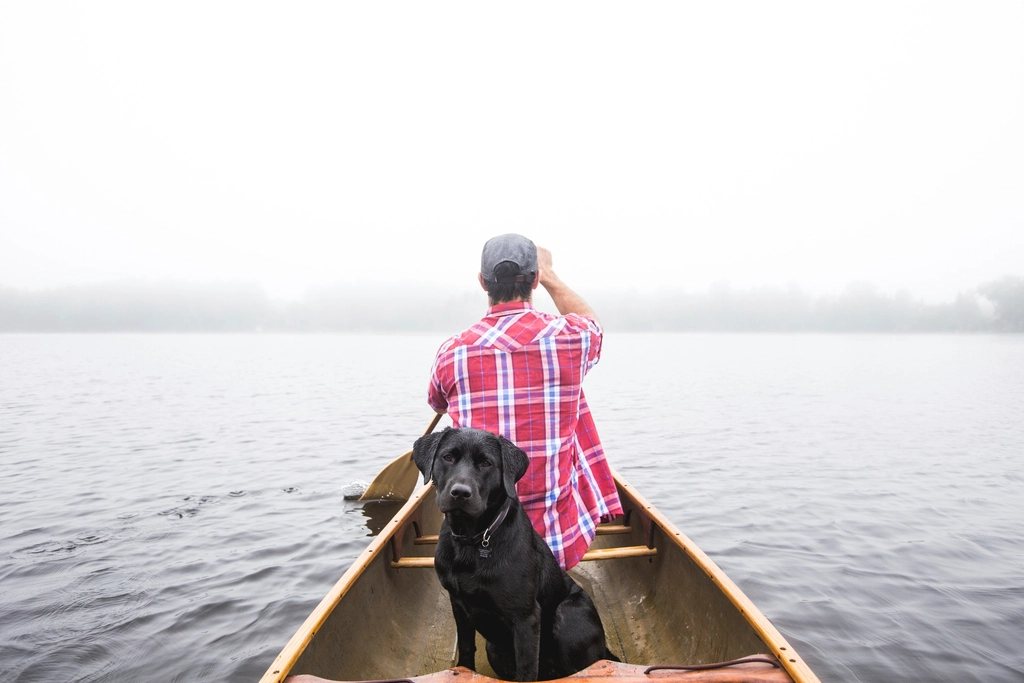
Most dogs can swim, but very few can swim for twenty minutes in cold water after falling out of a boat two hundred metres from shore. That gap between “can swim” and “is safe on the water” is why we treat paddling with a dog as a skill to be built, not a thing to try on a sunny afternoon. This guide covers the flotation vest, which is not optional, how to get a dog in and out of a canoe or paddleboard without tipping everyone in, and how to plan a first outing that ends with a dog who wants to come back.
Why every dog wears a life jacket
A dog’s natural buoyancy depends on body fat and coat, and it varies enormously. Lean, deep-chested breeds and heavy-boned muscular dogs sit low in the water and tire fast. Short-muzzled breeds struggle to keep their nose clear and can inhale water within seconds. Even strong swimmers lose coordination in cold water: below about 15 C, the gasp reflex and rapid muscle cooling that affect humans affect dogs too, and a lake in May or a river fed by snowmelt is often colder than that. A flotation vest keeps the head up, gives us a handle to lift the dog by, and makes a dark dog visible against dark water. We put it on at the car, not at the shore, and it stays on until we are back on land.
Life jackets by type and how they should fit
Dog flotation vests fall into three broad designs. The standard vest wraps the chest and back in foam panels, closes with two or three buckles under the belly, and has a grab handle on top; this suits most medium and large dogs. A vest with an added front float, a foam panel under the chin, is made for short-muzzled and heavy-headed dogs whose nose sinks first. A minimal vest with thin panels and a low collar suits confident swimmers and warm days, at the cost of some buoyancy. Whatever the design, fit is everything. The handle should sit over the shoulder blades, roughly above the dog’s centre of gravity, so that lifting by it raises the dog level rather than nose-down. Buckles should close snugly with two fingers of slack, and the vest should not rotate when we pull the handle sideways. We test in shallow water before the first boat trip: the dog should float level with its nose comfortably clear, and it should be able to swim without the vest riding up over its ears. A vest that does either of those things wrong is the wrong size, not a matter of adjustment.
Getting in and out without a swim
Boarding is where most first outings go wrong. A dog that leaps into a canoe from a dock lands on one side of the hull and the boat rolls. Our method starts on land: the canoe or board on the grass, the dog stepping in, sitting on a mat placed where it will ride, and stepping out again on cue, repeated until it is boring. At the water, we float the boat in ankle-deep water with one of us holding it steady, and the dog steps in over the side at the widest point, never over the bow or stern. In a tandem canoe the dog rides in the middle, on a non-slip mat, with the heavier paddler in the stern to trim the boat. On a paddleboard the dog rides just in front of our feet, where the board is widest and most stable; boards over 80 cm wide and 3.2 metres long are far easier with a dog than narrow touring shapes. Getting out is the same in reverse: shallow water, boat held steady, dog waits for the cue, then steps. A dog that learns to wait for the word will not bail out at the sight of a duck, which is the other way first outings go wrong.
Planning the first outing
We choose a small lake or a sheltered bay with no current, no wind forecast above 10 km/h and water warm enough to stand in comfortably. The first session is thirty minutes at most, within fifty metres of shore, and it ends early if the dog is trembling, panting hard or trying to climb onto us. A second person on shore or in a second boat is a real help the first few times. We bring water and a bowl, because dogs will drink from the lake and lake water carries giardia, and we bring a towel and a dry layer for the dog for the drive home. Sun matters: a dog on a board at midday has no shade, and pale-skinned dogs burn on the nose and belly. Morning and late afternoon are cooler, calmer and quieter, and quiet is the point.
On the water: paddling, wildlife and capsizes
A dog that stands up and moves around in a canoe is a rolling hazard, so we ask for a down or a sit and reward it steadily for the first few trips. Wildlife is the great test: a beaver slapping its tail or a heron lifting off will pull most dogs to the gunwale. We keep the leash off, because a leash attached to a dog that falls out of a boat can wrap a paddle, a thwart or a leg, and a dog tethered to a capsized boat can drown. If the dog does go in, we stay calm, keep the boat steady, and bring the dog alongside at the centre, lifting by the vest handle with one hand while bracing on the far gunwale with the other. On a board, we kneel, grab the handle and haul the dog across the board rather than up over the nose. If we capsize, the order is always the same: people first, then the dog, then the boat. Practising a deliberate capsize in waist-deep warm water with an experienced adult is the best hour we ever spent preparing for this.
Building up from there
After three or four short outings on flat water, most dogs settle into paddling the way they settle into a car: they lie down and watch. From there, we extend gradually, an hour, then a half-day, then a lake with a small crossing, always with the vest on and the shore in reach. Moving water, sea kayaking and multi-day trips are a different discipline and need a dog that is already relaxed, obedient and, ideally, small enough to lift with one hand. We would rather have a dog who finds the canoe slightly dull than one who finds it thrilling. Dull is safe, and safe is what lets the two of us spend a whole summer on the water.