
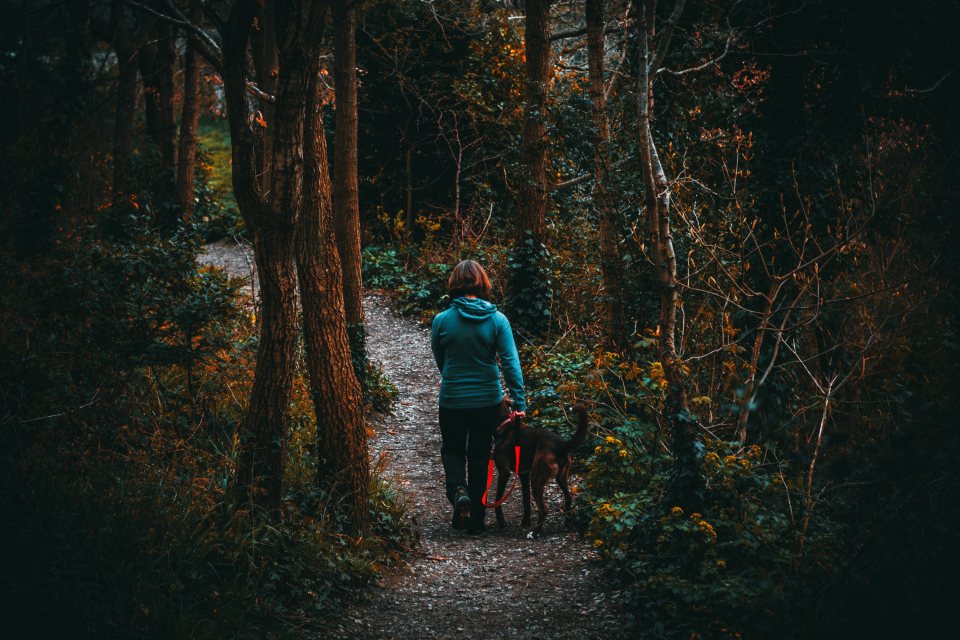
Every spring we hear the same question from friends who have just adopted a dog: how far can she go? The honest answer is that a healthy adult dog in good condition can often outwalk us, while a puppy, a senior or a flat-faced breed may be finished after three kilometres. Distance is not a number you look up; it is something you build, one outing at a time, while watching the dog rather than the map. This guide sets out what we have learned about matching the trail to the animal.
Start with age, not ambition
The single most useful rule for young dogs is the five-minutes-per-month rule: a puppy can handle roughly five minutes of structured exercise per month of age, up to twice a day. A four-month-old puppy therefore gets about twenty minutes of purposeful walking at a stretch, not a two-hour ridge walk. The reason is skeletal. The growth plates at the ends of a puppy’s long bones stay soft and open until somewhere between twelve and eighteen months, later in large and giant breeds. Repetitive loading on that cartilage, especially downhill pounding and jumping off rocks, is linked to joint problems that show up years later.
The rule covers leash walks and trail time, not the free play a puppy does in the garden, where the dog chooses when to stop. Short, frequent outings on soft ground are ideal at this stage. By twelve months a medium-sized dog can usually start on longer outings, and by eighteen to twenty-four months most dogs are physically ready to build real endurance. Older dogs run the clock in the other direction: from about seven or eight years, and earlier in giant breeds, stiffness the day after a walk is a sign to shorten the route rather than push through.
Breed type sets the ceiling
We find it more helpful to think in breed types than in individual breeds. Herding, hunting and sled types were selected for hours of sustained movement, and a fit border collie type, husky type or pointer type can cover twenty-five to thirty-five kilometres in a day with elevation. Terriers and many small breeds have surprising stamina but short legs, so a ten-kilometre walk for a person is closer to a fifteen-kilometre effort for them in terms of strides. Giant breeds carry a lot of mass on joints that wear quickly, and eight to twelve kilometres on gentle terrain is often their comfortable limit.
Brachycephalic dogs, the flat-faced types, deserve a separate paragraph. Their shortened airways limit how much air they can move, and panting, the dog’s main cooling system, is far less effective for them. Three to five kilometres on a cool morning is a fair target, and warm weather changes the calculation entirely. This is not a matter of willpower; a flat-faced dog will keep following you long after it should have stopped.
Fitness is built, not assumed
A dog that spends the week on a sofa is no more ready for a twenty-kilometre day than we are. We build distance the way runners do, adding roughly ten to fifteen percent per week and holding steady when the dog shows any stiffness. A sensible progression for a healthy adult dog starting from short daily walks looks like this:
- Weeks one and two: 4 to 6 km on rolling ground, two or three times a week, plus normal daily walks.
- Weeks three and four: 8 to 10 km with 200 to 300 m of elevation gain, once a week, shorter walks between.
- Weeks five to eight: 12 to 16 km with 400 to 600 m of gain, with a rest day after every long outing.
- After two months: 20 km or more, only if the dog recovers well and stays eager the next morning.
Weight matters as much as mileage. A dog carrying an extra fifteen percent of body weight is loading its joints far harder on every descent. If you cannot feel the ribs with light pressure, work on the diet before you work on the distance.
Terrain changes the arithmetic
Ten kilometres on a forest track and ten kilometres of alpine scrambling are not the same walk. Elevation gain is the biggest factor: we treat every 100 m of climbing as roughly equivalent to an extra kilometre of flat walking, for dogs as for people. Descents matter more than they seem, because a dog’s front legs absorb most of the braking force. Loose scree, sun-heated rock and long stretches of paved road each add wear on the pads, and a paw injury will stop a walk faster than tiredness ever will.
Temperature belongs here too. Above about 20 C we plan shorter outings and above 25 C we usually stay in the shade or leave the dog at home. Cold is easier for most coated dogs, but deep snow, where every step is a jump, can double the effort of a route.
Reading the dog on the trail
The map tells us the distance; the dog tells us whether it was too far. Early signs of fatigue are subtle: the dog stops ranging ahead and falls in behind, the tail drops, panting becomes heavier and does not settle at rest stops, and the dog begins lying down at every pause. A dog that suddenly slows and starts favouring a paw is usually dealing with a cut, a torn nail or a stone between the toes, not exhaustion. Any of these signs means we turn around, whatever the plan was.
The next morning is the second test. Reluctance to get up, a stiff gait on the stairs or a dog that sleeps far more than usual all mean the outing was a step too far. We note it, drop the distance by a third and rebuild from there.
A practical way to decide
Our own habit is to plan the route for the dog we have on that day, not the dog we hope to have by autumn. For an adult, fit, medium-sized dog we cap the first long walk of the season at about 12 km with modest climbing and go from there. We carry water for two, we bring a light first-aid kit, and we take a rest every hour whether the dog asks for it or not. Distance grows quietly over a season, and the reward is a companion that can share a full day in the hills with us for many years.