
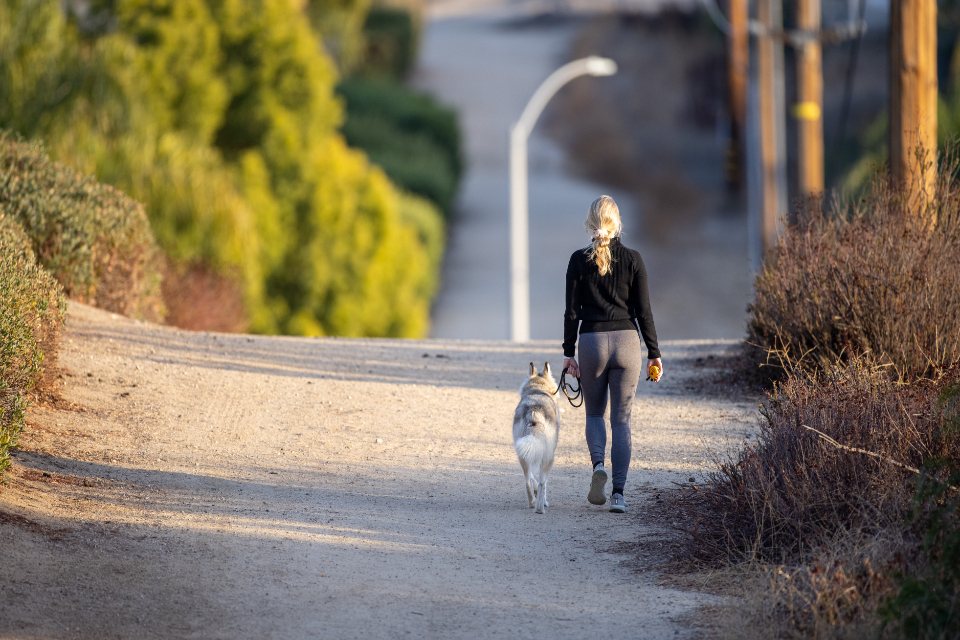
A dog that drags you down the trail is not being stubborn, and it is not trying to lead. It has simply learned, over hundreds of walks, that tension on the leash is what moves the world forward. Every time the collar went tight and the walk continued, pulling paid off. Loose-leash walking is the process of quietly reversing that lesson: tension stops everything, slack makes things happen. Done consistently, most dogs make real progress in about four weeks, which is also roughly the time it takes for a new habit to hold under mild distraction. The plan below uses two tools only: the stop-and-go and the 180-degree turn.
Why pulling works so well for the dog
Dogs repeat what pays. On a typical walk the payoff is constant: a smell twenty metres ahead, another dog, the park gate, the car door at the trailhead. If the dog leans into the harness and arrives at the smell, the lean is reinforced. From the dog’s side of the leash, pulling and arriving are linked, and the link is strengthened on every outing.
This is also why corrections rarely fix the problem for long. A jerk on the leash adds discomfort, but it does not remove the reward, and a motivated dog will take the discomfort as a fair price. The method that lasts is the one that removes the reward: the forward motion itself.
Equipment and the first decision
Before week one, choose a single setup and keep it for the whole month. A flat collar or a well-fitted harness with a front or back attachment, and a fixed leash of 1.5 to 2 metres. Retractable leads teach the opposite lesson, since tension is the normal state on them, so put them away for now. A treat pouch on the hip that the dog walks beside helps, because we want to reward at the seam of the leg, not in front of us.
Decide which side the dog walks on. It does not matter which, but it matters that it is the same side every time for four weeks.
Week one: stop-and-go in boring places
The stop-and-go rule is simple. The moment the leash goes tight, we stop, plant our feet and wait. We do not pull back, we do not say anything. When the dog turns its head, steps back or otherwise lets the leash go slack, we mark it with a quiet word and walk on. Forward motion is the reward; the treat is a bonus for the first weeks, given at the leg when the dog is beside us.
Start in the least interesting place available: a driveway, a quiet street, a car park at seven in the morning. Sessions are short, five to ten minutes, twice a day if possible. Expect the first outing to cover a laughable distance. Fifty metres in ten minutes is normal. The dog is learning that its own choices control the walk, and that lesson is worth more than any distance covered.
During this week, exercise the dog by other means. Play in the garden, do a sniffing session in a field on a long line, or run beside a bicycle if the dog is fit and fully grown. A dog that arrives at training full of unspent energy will fail, and we will be tempted to give up on the rule.
Week two: the 180-degree turn
By the second week most dogs understand that a tight leash stops the walk, but many will test it repeatedly toward something interesting. This is where the 180-degree turn comes in. As the leash tightens, instead of stopping, we say the dog’s name in a bright voice, turn on the spot and walk briskly the opposite way. The dog has to catch up, and when it draws level we mark and reward at the leg, then turn back toward the original direction.
The turn does three things. It makes the pull unproductive, because the goal recedes. It gives the dog a movement task that is easy to succeed at. And it keeps the walk moving, which prevents the frustration that a fourth or fifth stop in a row can produce in a young dog. Alternate stops and turns depending on the intensity: stop for mild tension, turn for a hard lean.
Timing matters more than force. The turn should begin as the leash goes tight, not three strides later; if we are late, we are simply walking a dog in circles.
Week three: adding distraction gradually
Now we move the sessions to progressively busier places, in an order the dog can manage. A useful ladder, from easiest to hardest, looks like this.
- A quiet residential street with occasional passers-by.
- The edge of a park, at a distance from other dogs.
- A path into the woods with fresh smells on both sides.
- The first hundred metres from the car at a popular trailhead.
- A narrow section of trail with dogs coming the other way.
If the dog fails twice in a row at a level, drop back one level and finish the session there. We want a high rate of success, not a test. Rewards can now come less often, but they should come at the moments that matter most, for instance the first ten steps after a distraction passes.
A sniff break is a superb reward at this stage. When the dog has walked twenty metres on a slack leash, we say a release word and let it go to the verge and read the news. Then we call it back to the leg and continue. Sniffing on cue turns the biggest competitor into an ally.
Week four and beyond: the trail itself
By the fourth week the rule should be holding on ordinary walks, and it is time to take it to the terrain we actually care about. On a trail the leash can be longer and the dog can be a little ahead, provided the line stays slack. The 180-degree turn works on single track too, though we will sometimes have to step off to make it. Uphill sections tend to bring the pull back, because the dog is working and forgets; a few stops on the first climb usually settle it.
Two habits will keep the training from fading. First, never let a tight leash produce forward motion, even once, even when we are late or tired or the parking meter is running. A single successful pull after weeks of the rule tells the dog that the old strategy still works occasionally, which is the most durable kind of reinforcement there is. Second, keep rewarding the good version now and then for the life of the dog. Loose-leash walking is not a trick that is finished; it is an agreement we maintain.
Four weeks is a guide, not a guarantee. An adolescent, a rescue with a long pulling history or a dog with a strong prey drive may need eight. What does not change is the logic: slack moves the world, and tension stops it. Hold that line and the dog will meet us there.