
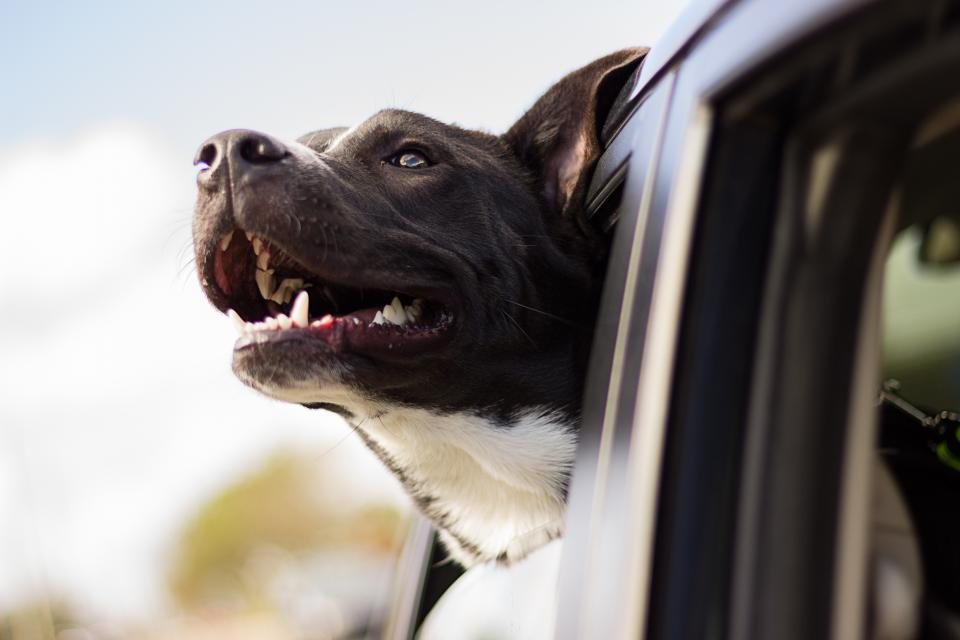
A long drive is often the first real adventure we share with a dog, and it is also the part of the trip where most avoidable accidents happen. Not on the trail, not at the campsite, but on the motorway at 110 km/h, or in a car park on a mild spring afternoon. This guide covers the three things we believe matter most: how a dog should be restrained in a moving car, why we stop every two hours, and how quickly a parked car turns into an oven. None of it requires special equipment beyond a properly fitted restraint, and all of it is worth getting right before the first kilometre.
Why a loose dog in a car is a problem for everyone
An unrestrained dog is a projectile in a collision. At 50 km/h, a 25 kg dog exerts a force roughly equivalent to several hundred kilograms on whatever it hits, which is usually a seat back, a windscreen or a passenger. It is also a distraction: a dog that climbs into the front, paws at the window or wedges itself under the pedals is a genuine driving hazard long before any crash. Many countries and several regions treat an unsecured animal as an unsecured load, and drivers can be fined or held partly liable after an accident. The rules vary widely, so we check the general road code of every country we pass through rather than assuming. Beyond the law, a restrained dog is a calmer dog, because it learns that the car is a place to lie down and wait, not a moving window on the world.
Restraints by type: harness, crate, barrier and carrier
There are four broad families of restraint, and each suits a different dog and a different car. A seat-belt harness is a padded chest harness with a short tether that clips into the belt buckle or loops through the belt itself. It works well for medium and large dogs who ride on the back seat, provided the tether is short enough that the dog cannot reach the front and cannot fall into the footwell during hard braking. A collar must never be used as the attachment point, because a sudden stop then loads the neck. A crate, whether wire, plastic or aluminium, is the most protective option when it is placed in the boot of an estate or SUV, oriented lengthwise and strapped so it cannot slide. A crate that rattles around loose is worse than no crate. A barrier or cargo divider keeps a dog in the boot area without holding it in place; it prevents distraction and stops the dog reaching the driver, but does little in a collision. A carrier is the right choice for small dogs under about 8 kg, placed on the floor behind a front seat or belted onto the rear seat. Whatever the type, the front passenger seat is out: an airbag deploying at over 200 km/h can be fatal to a dog sitting where a seated adult would be.
Fitting and habituating before the trip
A harness should allow two fingers under every strap and should not shift more than a couple of centimetres when the dog is pulled gently sideways. A crate should let the dog stand, turn and lie flat, but not much more, because extra room means extra distance to be thrown in a stop. We introduce whichever system we choose at home first: meals in the crate, a few minutes on the harness in the parked car, then a five-minute drive round the block, then twenty. Motion sickness is common in puppies, whose inner ear is still developing, and often fades by twelve to eighteen months; a light meal three to four hours before departure, a window cracked for fresh air and a view forward rather than sideways all help.
The two-hour break
We stop every two hours, which happens to be the same interval road-safety agencies recommend for drivers. For the dog, the break is about more than a toilet stop. Fifteen minutes of walking on grass resets the joints, the bladder and the mind, and an offer of water at every stop keeps the dog drinking small amounts rather than gulping a bowl at the end of the day and then needing out at midnight. We use a leash from the moment the door opens, because a dog that has been lying still for two hours is stiff, disoriented and inclined to bolt across a service-station car park. Where we can, we pick an exit a few kilometres off the main road and find a quiet lane rather than a lorry park. On a full day of 700 to 800 km, that means three or four proper stops and a driving day an hour longer than the satnav says.
The heat in a parked car, in numbers
This is the part that kills dogs every summer, and the numbers surprise almost everyone. On a day of 22 C outside, the interior of a closed car reaches about 33 C within twenty minutes and around 40 C within an hour. On a 30 C day, the cabin passes 45 C in under half an hour and can approach 55 C by mid-afternoon. Most of the rise happens in the first ten minutes. Cracking the windows a few centimetres changes the final temperature by only a degree or two, and parking in shade only delays the process, since the shade moves. Dogs do not sweat through their skin; they cool by panting, which stops working when the air they breathe is close to their own body temperature of 38 to 39 C. A dog whose core temperature reaches 41 C is in heat stroke, and organ damage begins within minutes. Ten minutes in a parked car in summer is enough. Our rule is simple: if the dog cannot come with us, one of us stays in the car with the engine and air conditioning running, or the dog does not come on that errand at all. If we see a dog in distress in a locked car, we note the number plate, alert the shop or venue and call the emergency services rather than waiting to see if the owner returns.
A short packing list for the car
- Restraint fitted and tested before departure, plus a spare leash in the door pocket
- Four to five litres of water and a collapsible bowl within reach of the passenger
- A towel, an old blanket and a roll of waste bags for the unexpected
- Vaccination record, microchip number and the address of a vet near the destination
- Sunshades for the rear windows and a thermometer if the car does not display cabin temperature
With the restraint sorted, the breaks scheduled and the parked-car rule agreed by everyone in the vehicle, the drive becomes what it should be: the quiet, slightly boring prelude to the good part. The dog sleeps, the kilometres pass, and by the time the tarmac gives way to gravel, everyone arrives ready to walk.