
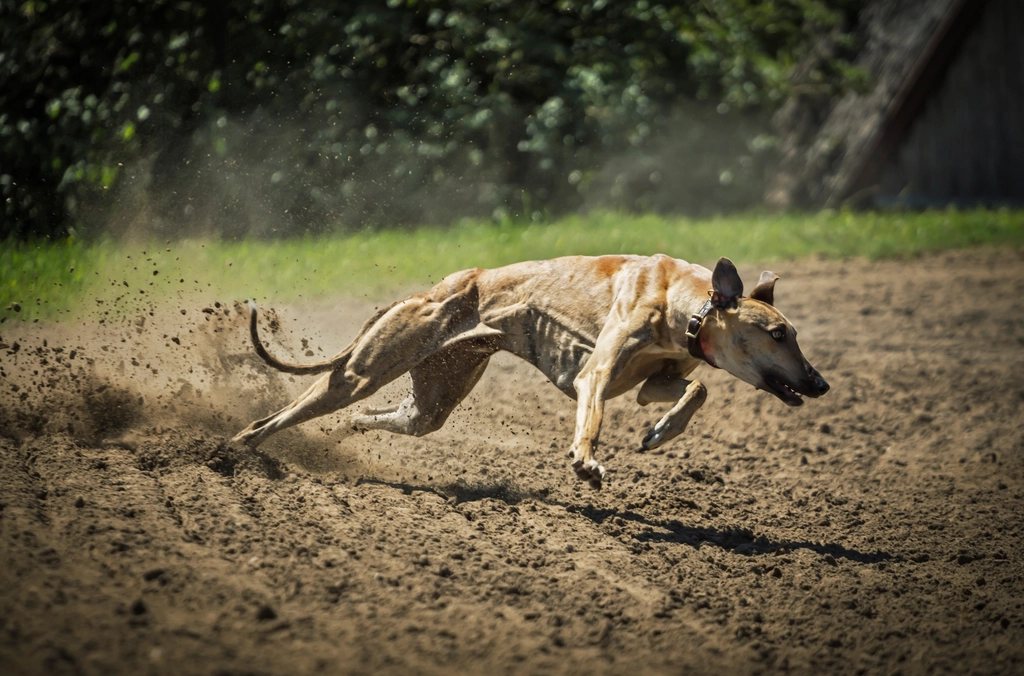
A dog that runs beside us on a forest trail is one of the great joys of owning an active breed, and a dog that pulls us up the same trail on a bungee line is something else again: faster, harder and oddly like teamwork. This guide covers both. The first half is about building a running dog from scratch, with the age limits, the weekly distance progression and the heat rules that keep the joints and the heart safe. The second half is an introduction to canicross, the sport of running attached to a dog, with the equipment, the commands and the etiquette that turn a chaotic sprint into a rhythm.
When a dog is old enough to run
Puppies should not run for distance. The growth plates at the ends of the long bones stay soft until they close, which happens at around twelve months in small breeds and as late as eighteen to twenty-four months in large and giant breeds. Repeated impact on open growth plates is linked to joint problems later in life. Until then, exercise is free play and walking, following the rough guide of five minutes of structured activity per month of age, twice a day. From the close of the growth plates onwards, a healthy adult dog of a running type can build up to surprising distances, but we begin with a vet check for the heart, the hips and the elbows. Breeds bred for stamina, herding and hunting take to it naturally; short-muzzled breeds, very heavy breeds and dogs carrying extra weight are better served by walking.
Building distance: the ten percent rule and rest days
We start a fit adult dog with runs of two to three kilometres, three times a week, on soft trail rather than pavement. Each week we add no more than about ten percent to the total distance, and every fourth week we hold steady or drop back. That progression takes a dog from three to ten kilometres in roughly three months, which feels slow and is exactly right. Signs that we are pushing too fast are easy to read if we look: lagging behind on the second half, lying down on the trail, stiffness the next morning, licking a paw, or a reluctance at the door that was not there last week. Pads toughen with mileage but wear through if the surface changes suddenly from forest floor to gravel, so we check them after every run for the first month. Two rest days a week are for the dog, not just for us, and a dog is never asked to run the day after a long hike.
Heat, water and the numbers that matter
Dogs cool by panting and by the small amount of sweat on their pads, and neither works well when the air is warm and humid. We run early or late whenever the day will pass 20 C, and above 25 C we do not run at all. Even at 15 C, a hard-working dog needs water every twenty to thirty minutes, offered in small amounts rather than a full bowl at the end. A dog that stops, seeks shade, drools thickly or whose gums go dark red is overheating and needs to be cooled with water on the belly and paws immediately. In cool weather the other risk is the opposite: a wet, thin-coated dog standing around after a run at 5 C chills fast, so the cool-down is a walk, not a rest. We feed at least two hours before a run and not for an hour after, because running on a full stomach raises the risk of bloat in deep-chested breeds.
Canicross: what it is and what it needs
Canicross is cross-country running with the dog harnessed and attached to a waist belt by an elastic line, and the dog is meant to pull. It began as off-season training for sled dogs and has grown into a sport with clubs and races across Europe and North America, most commonly over distances of about five kilometres. Three pieces of equipment define it. The dog wears a pulling harness, cut to distribute load across the chest and along the back rather than around the neck, which is why a walking harness or a collar will not do. The runner wears a waist belt, wide enough to sit on the hips and often with leg loops so that a sudden lunge pulls from the pelvis rather than the lower back. Between them runs a bungee line of about two metres with shock-absorbing elastic in the middle, long enough that the dog can run ahead but short enough that we can see and steer. The elastic is not a luxury: it turns a jarring tug into a steady lean, for the dog’s shoulders and for our spine.
Commands and the first sessions
The dog needs a small vocabulary before we clip in on a trail. A word to go, a word to slow, a word to stop, a word for each direction, and a word to pass a distraction without turning are the traditional set, drawn from sled-dog culture, and the exact words matter less than using them consistently. We teach them on walks first, on a normal leash, with the dog ahead, rewarding the turn when the word is said. The first harnessed sessions are short, on a wide track, at a jog, with the dog encouraged to pull rather than corrected for it, because most pet dogs have spent their lives being told the opposite. Pulling is the whole idea, and a dog that looks back nervously needs more praise, not more speed. Within a few weeks the line goes tight, the dog leans in and the pace climbs; many runners find their kilometre times drop by a minute or more, which is the moment to remember the ten percent rule still applies.
Trail etiquette when the dog is in front
A pulling dog reaches other trail users before we do, so the responsibility is doubled. We call the slow word well before walkers, cyclists and other dogs, shorten the line by taking a loop in the hand, and step off the track to let people pass. Races have their own rules, usually a minimum age for the dog of around twelve to eighteen months, a temperature ceiling above which the event is shortened or cancelled, a mandatory vet check and a ban on dogs overtaking without the pass command. Outside races, the same standards apply because the trail is shared. And on every run, harnessed or not, the dog’s needs set the pace. A dog that has learned to love running with us will run until it collapses if we ask; the job of the human on the other end of the line is to stop asking a kilometre before that.