
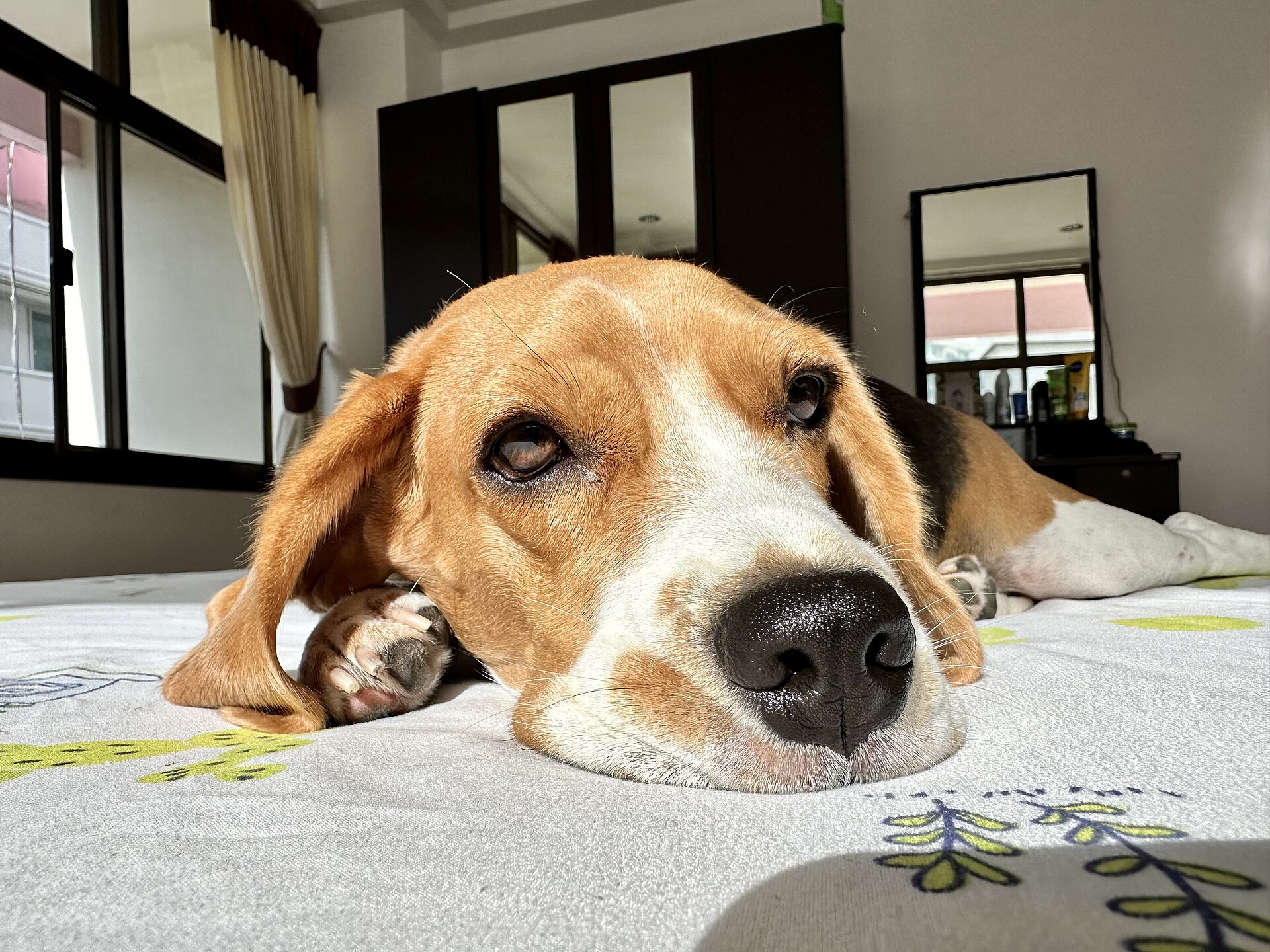
Some dogs do need sunscreen. Light noses, thin coats and bare skin burn easily. Choose a product made for pets, apply it to exposed skin, and reapply during the brightest hours.
Which dogs are at real risk from the sun?
Dogs are not all equally exposed. A thick, dark coat does most of the work for you. Thin or missing fur does not.
Sun damage can lead to discomfort and long-term skin problems, including cancer. That is why the dogs below deserve a closer look.
- Dogs with light-colored fur.
- Dogs with a thin or very short coat.
- Dogs with exposed skin on the nose, ears or belly.
- Dogs with light-colored noses.
- Dogs that have lost hair to allergies, hot spots, disease, surgical preparation or radiation.
- Dogs whose coat is shaved for the summer.
Hairless dogs and clipped breeds such as poodles fall into the same group. If you can see pink skin through the coat, treat that spot as unprotected.
Where does a dog actually burn?
The nose and the ear tips are the classic trouble spots. The skin around the lips is another. Any area with low pigmentation deserves attention.
The belly is easy to forget. So are the groin and the inner legs. Hair is very thin there. UV light can also bounce up from concrete and reach that skin.
Dogs that like to lie on their backs in the sun expose their bellies for long stretches. Watch for that habit on patios and lawns.
What does sunburn look like on a dog?
Look for red skin or hair loss. Sunburn can also irritate or worsen existing problems, such as allergies or hot spots. If you see red or sore skin, ask your vet before you try home fixes.
Why is human sunscreen a problem for dogs?
Dogs lick themselves. That is the whole issue. Most human sunscreens carry ingestion warnings, because their ingredients can be toxic if a child or a dog swallows them.
Baby sunscreen is sometimes used as a stopgap. It is still not the best choice for a dog that licks. If your dog is likely to lick the product, look for a pet-specific sunscreen.
Cats add another warning. Some sunscreen ingredients are unsafe for them, so never assume a dog product works for the cat in your house. Read the label for which species it covers.
How do you choose a pet safe sunscreen for dogs?
Start with the active ingredients. Two main families are on the market, and they behave differently.
Mineral formulas
Titanium dioxide is the main UV-blocking ingredient in some pet creams. A veterinary dermatologist quoted in one product review described it as largely considered the safest for dogs. Such a cream is not expected to cause side effects unless it is swallowed in large quantities. Thick, white mineral creams also show you where you have applied them.
Chemical formulas
Some pet sprays rely on chemical filters. Examples include ethylhexyl methoxycinnamate, octyl salicylate, homosalate and benzophenone-3. These sprays go on fast and suit hairless or clipped dogs. They are a poorer fit for dogs that lick, because some ingredients may upset the stomach if swallowed. Chemical products are also generally not reef-safe, so a mineral product is the kinder choice if your dog swims in lakes or the ocean.
What else to check
- The label names dogs as an intended species.
- It is fragrance free and non-staining.
- It blocks both UVA and UVB.
- It resists licking, rubbing and swimming if your dog is active.
- Your dog tolerates the smell and, for sprays, the noise.
What should you know about SPF on a dog product?
Do not expect an SPF number on a pet label. SPF labeling and claims are not permitted on products marketed for pets, because the FDA has not established a test to determine SPF values in pets.
What you will see instead is a comparison. Look for UVA and UVB protection similar to SPF 15 or SPF 30 for humans. Some makers describe their products as having an SPF equivalency in that range.
Treat any such figure as a rough guide. A higher number does not replace good application. A thin layer of a strong product protects less than a generous layer of a modest one.
How do you apply it, and how often?
The guidance for pets is at least 1 tablespoon of lotion or cream for each body area treated.
Apply it to the bridge of the nose, the ear tips, the skin around the lips and any thinly furred or low-pigment area. Add the belly and inner legs for dogs that sunbathe.
Reapply regularly. The guidance is every 4 to 6 hours during the brightest part of the day, from 10 a.m. to 3 p.m. Reapply sooner after swimming or heavy rubbing against brush.
- Test a small patch first and watch for irritation.
- Keep the product away from the eyes.
- Distract your dog for a few minutes after application so it does not lick.
- Check the coverage in daylight, not in the shade.
Does your dog hate the process? Short, calm practice sessions with treats help. Start with the nose only.
What else keeps a dog safe in the sun?
Sunscreen is one layer, not the whole plan. Plan the day around the sun.
- Walk in the cooler, lower-light parts of the day when you can.
- Offer shade breaks during long outings.
- Do not leave a dog lying on bright concrete, which reflects UV onto the belly.
- Consider protective clothing for the most vulnerable dogs, such as hairless or thin-coated ones.
- Keep a close eye on any dog whose coat has just been shaved.
Heat is a separate risk from UV. Shade and water matter for both. A cool, shaded rest is good for the skin and for the dog.
Frequently asked questions
Can you use human sunscreen on a dog?
It is not a good idea. Most human sunscreens carry ingestion warnings because the ingredients can be toxic if a dog swallows them. If your dog licks, choose a product made for pets.
Does pet sunscreen have an SPF rating?
Usually not. SPF labeling and claims are not permitted on pet products, because no test exists to measure SPF in pets. Look for UVA and UVB protection comparable to human SPF 15 or 30.
How often should you reapply it?
Reapply every 4 to 6 hours during the brightest part of the day, from 10 a.m. to 3 p.m. Do it sooner if your dog has been swimming or rubbing. Use at least 1 tablespoon for each body area.
Is sunscreen safe to use on cats too?
Not always. Some ingredients, such as octyl salicylate, should not be used on cats. A product labeled for dogs only may be unsafe for a cat.
Related reading
- Ticks and Dogs: How to Check, How to Remove One, and When Lyme Disease Is a Real Risk
- Understanding the shelter cat 3 3 3 rule for adoption
Sources
- 6 Best Dog Sunscreens of 2026 (Vet-Safe & Tested) (treelinereview.com, accessed 2026-11-02)
- Sunscreen for Pets (sanbrunopet.com, accessed 2026-11-02)
Photo: Beagle lying in the sun 4, by Slyronit, CC BY-SA 4.0 (Wikimedia Commons)